|
|
| |
|
|
|
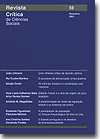
Nº 59
February, 2001
Price: 8 €
Em
Português
|
- João
Clímaco
- A critique of optimal
decision
This
article discusses and critiques the ideological framework which has led
to the preponderance of the concepts of utility and optimality as
fundamental referents for decision in the modern era. In this critique,
the author assesses the limits of traditional operational research,
which can only be surmounted by the adoption of a constructivist
approach. According to the author, only the viable contribution of this
approach can meet the demands of the civilization process.
- Rui Cunha
Martins
- The paradox of emancipatory
demarcation: the border in the era of its iconic reproductibility
This
article attempts to make a critical reinvention of the idea of the
border. Contesting (because of its inefficacy) the puristic ambition of
extracting from the concept, in order to make it workable, the vectors
of opacity, regulation, and constraint, and contesting also (because of
its acritical bend) the automatic conflation of transgression and
emancipation, the author proposes an alternative thinking which is
capable of dealing with the different dimensions of the concept, in the
context of what will be called positional heteronymy.
There is also a challenge in this: the acknowledgement of an aura-like
character in the border, in other words, how it can be -
because of its reproductive potential - the
presence of an absence .
-
- Sérgio Costa
- The social sciences and the
post-national constellation: Habermas, Beck, and post-colonial
studies
The post-national
constellation characterizes the contemporary context, in which a
considerable part of social processes are no longer bounded, in their
scope and reach, by the geographical frontiers of a nation-state.
Considering this constellation, the social sciences - consolidated
within the national institutional space and having the territorial
boundaries of the nation-state as their privileged unit of analysis -
face the need of reformulating many of their categories. This article
studies three recent proposals for overcoming the congenital bond
between the social sciences and national societies, pointing to some of
the limitations of each of them.
-
- Vera
Lúcia Calheiros Mata e
Artur
Nunes Gomes
- Gilberto Freyre, Casa
grande & senzala, and the myth of origins of the
Brazilian people
The authors investigate the
role that Gilberto Freyre had, through his major work Casa
grande & senzala, in the formation and preservation
of the Brazilian myth of national origin - that is, the belief that
Brazilian society derives from the harmonious fusion of three racial
matrices. The article argues that the Freyrian model of analysis, by
harmonizing the contrasts that exist in this society, allows the
persistence of the "myth of the three races" as the basis of the idea
of "being Brazilian". The authors conclude that the work of Gilberto
Freyre reveals the adaptative capacity of Brazilians and their tendency
to avoid conflict. This characteristic was apparent in the
commemorations of the 500 years of the Discovery of Brazil, during
which, in spite of the many protests that put in question the
(ambiguous?) harmonizing model of Brazilian society, it was obvious
that this model is still ideologically cultivated by the elites that
shape, and above all reproduce, the national ethos.
-
- António M.
Magalhães
- The transformation of the
mode
of state regulation and education systems: autonomy as an instrument
The
conferring of autonomy to the institutions of the education system is a
resource of political management of that system that corresponds to an
emerging mode of state regulation: regulation through deregulation. The
laws of institutional autonomy in Portugal seem to follow this pattern,
which has become established in the last decades in Western Europe.
This form of regulation is a correlate to the end of the model of the
welfare state, based on a fiduciary logic, and to the emergence of a
new model, based on a contractual logic of relations between the
different actors in the system. The latter does not correspond to the
establishment of a logic of pure deregulation, but to a reinforcement
of the Prince's arm, as several cases testify. In Portugal, this
situation is made more complex due to the historical and social absence
of consolidation of the welfare state.This context confers a hybrid
character to the policies and political instruments established to
manage the system, and autonomy itself emerges as an ambiguous set of
possibilities.
-
- Elisabete
Figueiredo e Filomena
Martins
- "A voice within"...
Expectations,
dispositions, and reasons of the population for participating in the
functioning of the Vale do Côa Arqueological Park
This
article aims to show, on the one hand, that the process of
establishment of the Vale do Côa Arqueological Park (PAVC) is
representative of the vulnerability of the institutionalized model of
participation, and on the other, to create conditions for a debate
about this issue. In this specific case, vulnerability is the result,
to a great extent, of two factors: first, because it is a direct issue
of the option not to build the dam, and second, because there is a lack
of dissemination of information among the social and economic actors in
the area. The first factor creates in local actors an attitude of
expectation and even of a relative "conformance" in relation to the
PAVC; the second may work either in a positive or a negative way, both
because of the expectations that it seems to create, and because of the
incapacity that it seems to generate in individuals and entities in
relation to the assumption of a clear position vis-à-vis the many
aspects involved in the establishment and functioning of the Park,
obviously including that of participation itself.
-
- Ana Cristina
Santos e Fernando
Fontes
- The Portuguese State and
the
challenges of (homo)sexuality
During the last
decade, we have witnessed protests, demands, and debates around the
rights of homosexuals. The Portuguese State constrains homosexual
identity through the operation of obstruction mechanisms, such as
juridical-legal omission or non-regulation of laws previously approved
by Parliament. The ambiguity between text and juridical effectiveness
has been the most characteristic form of action of a State which, in
this way, attempts to sanction the principles of equality and
non-discrimination established by the European Union, while it
legitimates simultaneously a rigid morality, heir to centuries of
religious puritanism and to the absence of critical opposition. This
article seeks to take into account these and other contradictions,
analysing the role of the State in the process of assertion of
homosexual identities in contemporary Portuguese society.
|
|
|