Revista Crítica de Ciências Sociais
|
| |
|
|
| |
|
|
|
Nº 61
December, 2001
Price: 8 €
Em Português En
Français
|
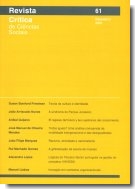
Susan Stanford Friedman
"Border Talk", Hybridity, and Performativity: Cultural Theory and Identity in the Spaces between Difference
Refusing the old metaphors of the mosaic and the melting pot as inadequate for theorizing identity in a multicultural context, the author proposes instead the image of the borderland, of a "space in-between". She sets in conjunction three current rhetorics of identity which are a pervasive feature of cultural studies across the disciplines: "border talk", "hybridity talk", and "performativity talk". Whereas these rhetorics seem quite distinct, if not contradictory, actual narratives of and about identity often set in motion all three, establishing a fluid borderland where boundaries are frequently transgressed. In the final part of the paper, the author discusses the work of two contemporary North-American writers, Anna Deavere Smith and Gish Gen, showing how each blends and conjoins the contradictory nature of borders, the different models of hybridity and debates about its politics, and the distinct rhetorics of performance and performativity in cultural theory.
João Arriscado Nunes
Jurassic Park Syndrome: (An) Edifying Tale(s) about Genetics in a World "without Guarantees"
Between the utopia of prediction and control and the dystopia of the uncontrollable proliferation of monsters and undesirable effects, genetics appears as the site of intersection of multiple processes and the site of articulation of the biological and the cultural, the natural and the social, a privileged object of new forms of "governing life", the field in which contradictory conceptions of what we can call biopolitics confront one another. This text explores, on the one hand, the connections between the "molecular vision of life" and its critiques, and, on the other, the "unruly complexity" of the new fields of biopolitics.
Aníbal Quijano
The Return of the Future and Questions of Knowledge
Beginning with a brief reflection on the disappearance of the dimension of the future from the critical horizon in the last decades of the 20th century, this text examines the relation between the imaginary, social actions, and modes of knowledge production. It concludes that there is a need to explore a parallel horizon of knowledge, based on a non-eurocentric rationality, and capable of opening the way for a return of the future as an emancipatory category.
José Manuel de Oliveira Mendes
All Equal? A Comparative Analysis of Intergenerational Mobility and Social Inequalities
The text compares class structures and patterns of social mobility in four countries which have different logics of insertion into the capitalist world system (Portugal, the Czech Republic, Sweden and Canada). Contrarily to what some liberal theories assert, the author concludes that the convergence between countries is not related to a hypothetical proximity in terms of their stage of capitalist development. Among the three dimensions used to evaluate the relative openness of social structures and the degree of democratization of the four countries, it is qualifications, i.e. cultural capital, which constitute the major obstacle to intergenerational mobility. Portugal is the country where the social structure presents the greatest degree of closure to individual mobility. Finally, this paper shows the crucial role of gender in the structuring of inequalities and in the dynamics of exploitation.
João Filipe Marques
Racism, Ethnicity, and Nationalism. What Articulation?
Most sociological and political reflections about contemporary societies deploy racial, ethnic and national categories in an essentialist or reifying manner. The concepts of racism, ethnicity, and nationalism have been used as explanatory tools, when in fact they often need to be explained. The aim of this paper is to highlight the socially constructed character of these categories and to explore at the same time the logical articulation between the phenomena of racism, ethnicity, and nationalism.
Rui Machado Gomes
The Globalization of Mass Schooling: Institutional and Genealogical Perspectives
The critical analysis of some of the aporias of two influential explanatory models of the inception and expansion of mass schooling - the models of State formation and of the worldwide institutionalization of education - provides the conceptual framework for the construction of the genealogical perspective which the author defends. The latter is based on three pillars: the premise of discontinuity; the denial of the existence of an educational moral imperative based on principles; and the contingent character of the political technologies used by educational systems. The research concurs with the perspective of those authors who have sought an alternative based on the notion of contingent political technologies as a counterpoint to the traditional models of the relation between the State and education.
Alexandra Lopes
Logics of the Third Sector in Portugal in the Management of the HIV/AIDS Complex
The trajectories of the processes of political decision in the field of AIDS and the participation of non-profit private agents in those processes are important elements for a better understanding of the logics of operation and development of the Third Sector in Portugal. This paper seeks to present some empirical data on the process of affirmation of a dividing line between activism and provision of services in what relates to the participation of non-governmental agents in the management of HIV/AIDS. It demonstrates that this dividing line is rooted in a double move of politicization of action in the voluntary sector, on the one hand, and reproduction of the structural weaknesses of the Portuguese formal civil society, on the other.
Manuel Lisboa
Innovation in Organizational Contexts: The Modernization of Portuguese Industry
Considering innovation in companies as an essential strategic element for the development of the economic fabric of modern societies, this paper begins by discussing the concepts and the theories which are best suited to the study of Portuguese reality. It then confronts them with the results of an empirical research study on the manufacturing industry. Despite the great variety of situations encountered, the results show that it is possible to construct a technological and organizational profile associated with innovation: companies which innovate and show the best indicators of development potential are those which are better organized and technically equipped from the start. Thus, there is a logic of reproduction of already existing conditions which can contribute to an even greater polarization within an already unbalanced industrial structure.
|
|
|