
Workshop Series
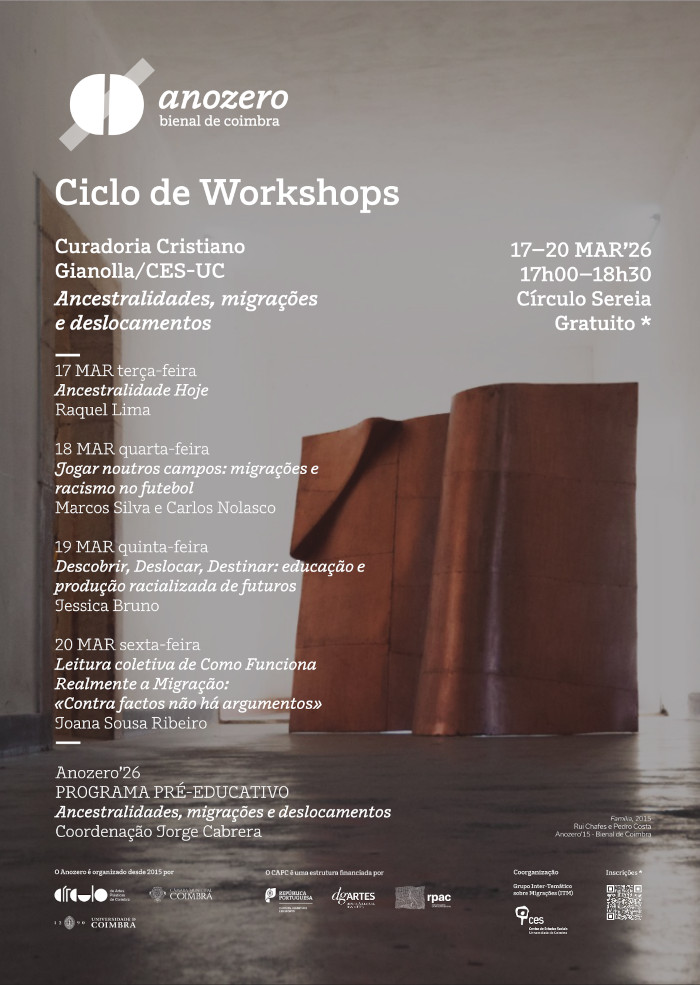
Ancestries, migrations and displacements
17, 18, 19 e 20 de março de 2026 | 17h00-18h30
Círculo de Artes Plásticas de Coimbra - CAPC (Círculo Sereia / Municipal Cultural Centre)
People walking in the rural area of Mehran (Iran)
© Mostafa Meraji / Unsplash
Workshop 1 | Ancestry Today | 17 March 2026, 17:00-18:30
With Raquel Lima
Synopsis | A talk about the importance of claiming the legacies left by distant members of a community for posterity. Concepts such as circular community, vernacular practice, transgenerational forces, and karmic cycles will be explored, with a view to understanding how postcolonial heritage shapes understandings of contemporary issues. Based on her artistic work and her experience in the Black diaspora, the aim is to reflect on approaches to memory, from the intersection where different languages, territories, generations, disciplines and diasporas meet, to suggest a reflection around two axes: narrative and ritual. Narrative as a form of knowledge that allows us to know, tell and transmit worldviews, and ritual as a means of transmission and nourishment through practices of self-care, healing and liberation. Participants will be invited to share their experiences and carry out exercises mapping their ancestry today.
Oficina 2 | Playing on other fields: migration and racism in football | 18 March 2026, 17:00-18:00
With Marcos Silva e Carlos Nolasco
Synopsis | This workshop proposes a critical reflection on migration and racism in football, taking as its starting point the biographical stories of players who have made movement, adaptation, and resistance central to their life journeys. Football, as a global phenomenon, is also a reflection of the social, political and cultural dynamics that cross borders, bodies and identities. Through life stories, we analyse the migratory paths of these athletes, the challenges and experiences of racial discrimination and the multiple forms of exclusion that persist on and off the pitch. Strategies of resistance, overcoming, and affirmation are also highlighted, giving visibility to voices that transform football into a space for struggle, denunciation, and social change, inviting reflection on how prejudices and racist practices arise across different cultures. In a participatory environment, the aim is to foster debate, critical thinking, and the development of more conscious views on the role of sport in reproducing racism, as well as in combating it.
Oficina 3 | Discover, Displace, Destine: education and racialised production of futures | 19 March 2026, 17:00-18:00
With Jessica Bruno
Synopsis | The workshop starts from a critical shift in the historical notion of ‘discoveries.’ In the colonial imagination, discovery was presented as a gesture of revelation and inauguration of the world. However, it actually operated as an act of concealment. It covered up knowledges, cosmologies, and existences, establishing hierarchies of humanity. This workshop proposes to mobilise ‘discovery’ in another sense, that of revealing what was covered up by the narrative of neutrality that accompanied and legitimised the colonial project, bringing to the surface the processes by which the school participates in the racialised production of the future. By articulating accounts of the school trajectories of students of African descent with family histories marked by migration, post-colonial displacement and escape from war contexts, the session proposes to reflect on how displacements that cross national borders are not limited to geographical mobility, but extend within the nation. In this sense, discovery designates not only criticism of a hegemonic historical narrative, but also the exposure of a contemporary regime that continues to manage displacements within educational institutions through the differential fabrication of educational trajectories based on racial hierarchies.
Oficina 4 | Collective reading of How Migration Really Works: ‘There is no arguing with facts’ | 20 March 2026, 17:00-18:00
With Joana Sousa Ribeiro
Synopsis | This workshop presents a collective reading of Hein de Haas's book, a longtime researcher of migratory phenomena and population displacement. Based on the book How Migration Really Works - A Factual Guide to the Most Divisive Issue in Politics, the workshop proposes to deconstruct, with the audience, some misconceptions about migrants. Among others, these include: migration as a problem or as a solution; climate change as a factor in mass migration; and border restrictions as an effective means of controlling migration. The aim is to contribute to the dissemination of scientific knowledge in this area at a time when public and political debate is mired in misinformation, polarisation and populisms.
______________________
Event organised by ITM | Inter-Thematic Group on Migrations, curated by Cristiano Gianolla (CES). The registration is free but compulsory.
This series of workshops is part of the pre-educational programme of ANOZERO'26 – BIENAL DE COIMBRA (Curated by Hans Ibelings & John Zeppetelli, Assistant Curator Daniel Madeira), entitled ancestries, migrations and displacements, and is coordinated by Jorge Cabrera